
The Results
Intro to Study Results
The most successful horn players are those who have found the most ideal embouchure set up that benefits their technical skills, leaving no room for detrimental habits to form. In my personal study that was conducted across a wide variety of professionals, students, and amateurs, correlations were found when comparing embouchure setup, gender, ethnicity, lip size, and technical deficits. These results are considered preliminary, as this study needs repetition at another level to truly secure and solidify what these preliminary results state today.
One of the biggest determining factors if an embouchure setup is correct is if a player has any weaknesses they can pinpoint in their playing. These weaknesses include, but are not limited to: high/low register, shifting or moving between different registers of the horn, articulation, endurance, etc. Participants reported their weakness, if applicable to them. While a large number of players did not report any weaknesses, nearly half of the participants did report at least one. The majority of weaknesses were in range, both high and low, endurance, and shifting between registers. Using the participant groups, Caucasian Males, Caucasian Non-Males, Non-Caucasian Males, and Non-Caucasian Non-Males, the individuals who reported certain weaknesses were then cross examined with which embouchure setup they play with. Participant groups were then compared by gender and ethnicity to find which embouchure setups produced the least amount, or no, deficits. At the end of the chapter, the cumulative results will be revealed as to what trends are found, and which embouchure setups truly could result in less technical deficiencies when playing. This study needs additional analysis such as playing exams, trial embouchure changes, and the consideration of mouthpiece sizes. These analyses will be considered for future research.
Part I:
Range Weakness & Embouchure
Range was the largest reported weakness among participants. Exactly 50% of the people who play standard reported a range deficit; 57.14% of people who play 50/50 reported a range weakness; and 33.33% of those who play one-third upper lip reported a range weakness. From there, participant categories and their percentages were found for both how many had the deficit and how many did not. This was calculated by dividing how many had or had not had this deficit by the total number of people who played with that embouchure set up in their individual participant categories. For an embouchure to be a valid contender, the percentage of those with deficits must be less than 40% and the percentage of those without the deficit must be greater than 60%. Table 5 below reflects these calculations for range weaknesses and the standard approach.

When comparing all the groups together, it can be seen that the group with the least amount of deficits are the Caucasian Males, and the group with the most number of people without the deficit is also the Caucasian Males. This in turn tells us that this embouchure setup is a possible contender to be the best setup for Caucasian males overall. However, Caucasian Non-Males and Non-Caucasian Males are both examples of this possibly not being an ideal setup for these groups of people. These two groups have a greater number of people with deficits than without deficits and prove to be a non-viable option for the Non-Caucasian Males and Caucasian Non-Males.

For range weaknesses among those who play with 50% of each lip inside the mouthpiece, Table 6 clearly shows that this method of playing is only viable for Caucasian Non-Males. No participants in that category have the deficit, therefore 100% of Caucasian Non-Males playing 50/50 do not have a deficit. All the other categories did not meet the less than 40% and greater than 60% with deficits to without deficits, therefore, all other participant categories do not have 50/50 as a viable embouchure set up option.

The One-Third Upper Lip embouchure set up has shown to be an interesting option in this study, and the only one that will usually have drastic results. With the range weakness, data reports that this is a viable embouchure option for both Male categories, Caucasian and Non-Caucasian, and nonviable option for both Non-Male categories.
Part II:
Shifting Weakness & Embouchure
The next highly reported weakness among players was shifting between registers. This is a technique that is commonly hard for many and could definitely be a result of not playing with a correct embouchure set up. Shifting between registers requires a lot of facial manipulation, aperture/embouchure strength, and stability, as previously mentioned in the preceding chapter. When these facial mechanics do not correlate, there is a disruption, or wrench in the machine if you will, that causes a break in the sound. It can result in not hitting notes, needing to completely reset with a different embouchure set up, and audible gaps in the sound.

The weakness of shifting while playing with the standard approach seems to be a non-issue for the majority of participants besides Non-Caucasian Males. This group of people is very close to having the standard approach being a viable option but misses the mark slightly with 42.86% of those having the deficit, and 57.14% of them not having the deficit. While this result leans towards more people not having the deficit, the margins are still too close for this embouchure set up to be a good fit. On the other end, Non-Caucasian Non-Males have 0% deficits, and 100% without the deficit. While these results are good from an exterior appearance, it’s important to take into consideration that the results can be skewed by the amount of people who participated in the study.

The 50/50 approach is an extremely viable option for both Caucasian groups, as well as Non-Caucasian Males. These three groups had no one with a deficit in this category when playing with this embouchure setup. Non-Caucasian Non-Males, however, have 50% for those with deficits and those without. There needs to be more research done to determine the viability of this embouchure setup, but for the purpose of this study, the result is determined that this is not a viable option, at this moment.

In the case of shifting weaknesses while playing with one-third upper lip, both Non-Male groups find themselves with 0% participants with that deficit. This makes this method of playing a viable option for these two groups. On the other hand, both Male groups are at 50% of participants with the deficit, and 50% without the deficit, and at this current moment, this is not a viable option for both of these groups. As stated before, this method of playing in regard to this specific weakness needs more data to find a more sound result. It is always possible that the results could come out the same, but to confirm this, more research is needed.
Part III:
Endurance Weakness & Embouchure
Endurance is the last weakness studied. While many can argue that endurance is heavily influenced by the amount one practices and how much of a workout one does, endurance can also be affected by improper musculature used due to a poor embouchure setup. This then can lead to injuries that could alter one's career in the field of music. Injuries can be avoidable if one has the proper setup.

Nearly all these groups are found to have the standard method as a viable option of playing. The Caucasian Males miss the mark ever so slightly with 41.18% of them having the deficit, and 58.82% not having the deficit. This could easily change with a little bit more data and research done in this specific area.
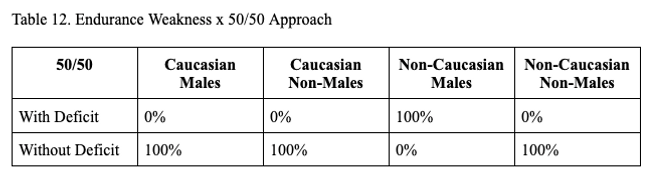
This category shows that nearly all groups have the 50/50 upper to lower lip approach as a viable option. While three of four of these groups show that their participants have no deficits, all Non-Caucasian Males who play with this setup have endurance as a weakness, making it a nonviable option.

As seen previously with the shifting weakness and one-third upper lip approach, the two Non-Male groups’ results deem this an extremely viable option with 0% of participants with the deficit. I believe that this is a trend that could be seen with more research. This is, however, not a viable option for either male group as 50% have the deficit, and 50% do not. The results are not clear enough to determine that it would be a good option.
Overall Results and Recommendations
Ultimately determining these individual results then allows for the cumulative results to be concluded. Out of all three weakness categories, each individual result is then grouped together to see which embouchure setup will be the best for specific groups of people.

The results for each participant category are determined by combining the results of each weakness category and its viable/nonviable options. For Caucasian males, the standard approach was a viable option for two out of three weakness categories, overall making the standard approach a good embouchure set up for Caucasian men. The 50/50 approach was a viable option for two out of three weakness categories as well, additionally making this a good embouchure option as well for Caucasian men. The one-third upper lip approach, however, was only successful in one weakness category, making this embouchure setup unsuccessful for Caucasian men.
For Caucasian non-males, each approach, standard, 50/50, and one-third upper lip, were all successfully viable options with two out of three, or three out of three, weakness categories making any of the approaches an ideal setup. On the opposite end of the spectrum, non-Caucasian males only presented with one viable option out of all three categories, for all three approaches. Therefore, the non-Caucasian male segment needs more data and research to conclude a true viable option for an embouchure set up. Lastly, for non-Caucasian non-males, the standard approach and the one-third upper lip approach are successful options, both with two out of three weaknesses being viable for each embouchure setup. The 50/50 approach only had success for one of three weaknesses, therefore, this embouchure setup would not be recommended for non-Caucasian non-males.
Some conclusions regarding gender and ethnicities can also be drawn from these preliminary results. Non-Males have a higher success rate when using the one third upper lip embouchure technique than Males, and Caucasians have a higher success rate with the 50/50 embouchure technique than Non-Caucasian participants. I believe that in the case of the one third upper lip technique that divides male and non-male participants, the difference in upper vermillion height and where the mound on the upper lip rests in comparison to each other is the determining factor. Non-male upper lips tend to be larger than males. Therefore, there is more surface area to be able to place the mouthpiece lower on the upper lip. Since the lower lips are much closer in size compared to their racial counterparts, it does not seem like this plays in as a factor at this current moment. For the 50/50 technique, this was not a recommended or viable option for Non-Caucasian participants, whereas it was much more viable for Caucasian participants. It is believed that this has to do with the overall lip proportion. Because Non-Caucasians have about a 50 split 50 of upper to lower lip, compared to Caucasians, whose total vermilion height is made up of one third upper lip and two thirds lower lip, it makes it more difficult for Non-Caucasians to put half of each lip inside the mouthpiece equally. It would be too much of each lip trying to fit inside the mouthpiece, which would prevent a buzz in the aperture from being created. With a different amount of each lip in the mouthpiece, following either the standard approach or the one third upper lip approach, it would eliminate too much of each lip inside the cup, which would result in a more comfortable and natural feeling embouchure setup.