Facial Features

Facial features
Biological facial features are what truly sets one human’s physical appearance apart from another. While genetic distribution of both parents’ genes is what creates the outward appearance of an individual, it is the deeply rooted genetic factors that boil down to specific contrasting traits in various genders and ethnicities. In the case of embouchure setups, these traits in particular are specific to the lower portion of the face; these features consist of the lips, jaw, dental structure, and the surrounding musculature. Looking closely at photographic evidence of these anatomical differences, which is supported by scientific data, allows conclusions to be drawn in regard to French horn playing. It is impossible not to consider the variability of maxillofacial features when learning the crucial embouchure setup as it will make, or break, the overall playing experience.
Primary facial features that are the most important in regard to embouchure set up consist of the mouth and lips. The total vermilion height, individual (upper and lower) vermilion heights, and protrusion of the lips contribute greatly to the way one is able to set up their embouchure due to how much lip can properly fit inside the mouthpiece with little to no manual manipulation. The problem arises when students are pushed to play with this standard approach, even though their physical attributes do not coincide with those of the Caucasian male, which the standard approach is based upon. The sizes of these features vary greatly, and since the lips are the primary source of where the vibration is created and the mouthpiece is placed, it is important that we take this into consideration when initially developing an embouchure. Richard Deane states, “The idea here is to take stock of our own unique physical set-up and then manufacture a system which will work over the 4-octave range of the horn.”
Total Vermillion Height
Lip (vermilion) heights are essential to concluding correct embouchure placements for those male and non-male, of Caucasian ethnicity, and for those of other ethnicities such as Black, Asian, Hispanic/Latino, etc., as well. The upper vermilion is essential for flexibility and tone quality, while the bottom vermilion is essential for acting as an anchor for the mouthpiece to be placed, creating a secure seal between mouthpiece and lips. Bottom vermilion also impacts sound quality, as well as projection in certain ranges such as the low register of the horn. The total vermilion together impacts all fundamentals on the French horn; therefore, without proper placement for each individual person, technique will suffer due to incompatible lip ratio in the mouthpiece.

Table 1. reports the mean and range of the total vermillion height for each participant category, as well as the overall mean of the categories combined. The collective data of each participant category also includes the standard deviation, which reports how spread out the data is from each point. As one will notice with this data, sizes of the total vermilion height will differ due to some having less and some having more surface mass in that region of the face. People who have fuller lips do tend to struggle with embouchure set up due to not enough lip being about to fit inside the mouthpiece to create the necessary vibration, or the correct aperture size. Because of this, students are often taught incorrectly by those who may not fully comprehend the difficulty of fuller lips versus the small, conical shaped mouthpiece. For students with more protrusive lips, many must learn how to do this carefully and concisely to avoid injury.
The mean of the collective data showed 18.70 millimeters; however, the range of the total vermilion lip height is important to note. The range of total vermilion heights combined ran from 8.00 to 32.00 millimeters. Some Caucasian participants in this study had a very small combination of only 8.00 millimeters total vermilion height, and their range distance ran to nearly the highest report of 32.00 millimeters, whereas Non-Caucasian participants’ baseline started at 15.00 millimeters spanning to the max of 32.00 millimeters. Where the Non-Caucasian participants’ baseline starts is nearly the average of the Caucasian categories total vermilion reports. This gaping distance makes an extreme difference when deciding how to place the mouthpiece on the lips.

The standard deviation of all participants’ total vermilion heights determines and reports how spread out the data is between each data point. The standard deviation is used to record the margin of error from the mean, dependent on the 68-95-99 rule of confidence levels, which tells one what is statistically expected within certain parameters, or within the three standard deviations. Once the mean, standard deviation, size of the sample study, and confidence levels are determined, one is able to find the margin of error, and confidence intervals of the upper and lower levels. In Table 2., each of these are reported for the total vermilion height amongst all participants. At the 68.30% confidence level, a margin of error of 0.78 millimeters was reported, which then allowed the confidence intervals of the lower level and upper level to be determined. The lower and upper levels are found by adding the margin of error to the mean, and subtracting the margin of error from the mean, leading to the result of 17.92 millimeters and 19.49 millimeters. These numbers in correlation with the confidence level state that the mean will be found 68.30% of the time between 17.92 millimeters and 19.49 millimeters. The same is similar for the 95% confidence level and the 99.90% with their specific data; 95% of the time, the mean will be found between 17.19 millimeters and 20.22 millimeters due to a margin of error of 1.52 millimeters, and 99.90% of the time the mean will be found between 16.16 millimeters and 21.25 millimeters due to a margin of error of 2.54 millimeters.
The results in Table 2., in conjunction with the data from Table 1., show that between all races and genders, the mean will lie somewhere between 16.16 and 21.25 millimeters 99.90% of the time. This allows one to confidently compare results of the individual participant categories. While the mean will never reach the highest of the Non-Caucasian Non-Male participants resting at a 23 millimeters mean, it will lie somewhere between a bit lower than the Non-Caucasian Non-Male mean results, as well as a bit lower than the Caucasian Non-Male mean. This also allows a determination to be made that the results of the total vermilion height for Non-Caucasian Non-Males were in the mid to high range, and many of the results for Caucasian Non-Males were in the lower/middle part of the range.
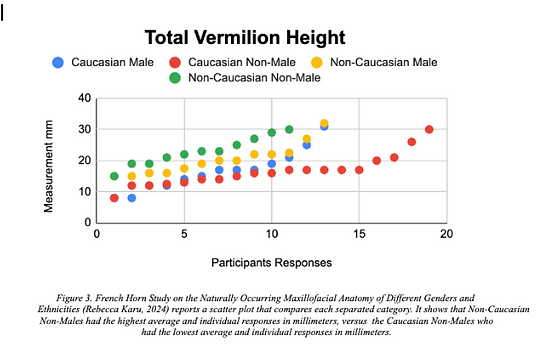
In Figure 3., it can clearly be seen where each category falls in terms of the data as a whole. It compares each category's participant responses, showing those with the highest vermilion heights (Non-Male Non-Caucasian), and the lowest (Non-Male Caucasian). The X-axis represents the individual participants, while the Y-axis represents the total height of the vermilion. This visual representation allows one to understand that there is a significant difference in total vermilion sizes; however, there are fundamental and biological explanations that coincide with the numeric data. Macrocheilia, also known as excessive lip size, is common among a variety of ethnicities outside of the Caucasian race. Ethnicities such as Asian, Hispanic, and African American are scientifically proven to have more protrusive lips due to more soft tissue mass in that specific area of the face. This additional soft tissue greatly affects the size of the lips, both individually and as a whole. Disclaimer: Dimensions of the face do have potential to fluctuate due to factors such as dental structure, surgery, and endocrine function. African Americans are prone to a bimaxillary protrusion dental structure which causes the teeth to protrude anteriorly due to the angle of the maxilla and/or mandible bones causing the lips to be larger and more pronounced.
Individual Vermillion Heights
Individual vermilion heights are important to analyze for the purpose of identifying the ratio of lips that can be put into the mouthpiece. Caucasian’s have a typical proportion of vermilion heights; the top lip is approximately one-third of the entire vermilion height, while the lower lip is approximately two-thirds of the entire vermilion height. Other ethnicities have a tendency to be larger in all directions. Because of these contrasting proportions, this is another example of a facial feature that differs greatly among various ethnicities and genders, as well as affects the way students set up their embouchures.

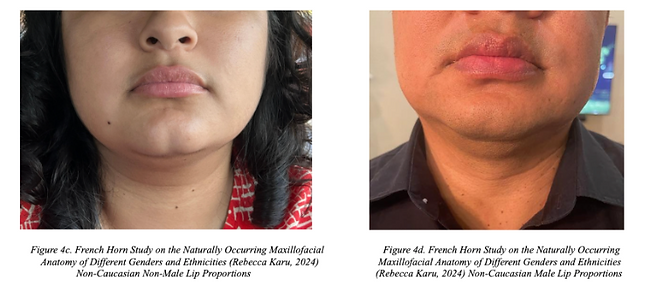
In Figures 4a. through 4d., the proportions of the top lip to the bottom lip in different genders and ethnicities is visually apparent, as is the difference in protrusion and size of the lips themselves. It is extremely noticeable that the Caucasian examples do in fact have the one-third upper lip to two-thirds lower lip proportions while the proportions for the Non-Caucasian participants nearly fall to a 50/50 split. These proportional differences impact the way one can naturally or intentionally place their mouthpiece on their face. There is a protrusive mound that can be felt on the upper lip in the center where the cupid’s bow is found. It has always been recommended for horn players to place the mouthpiece above the mound, rather than directly on it. This idea is again, based on Farkas’s beliefs centering around the Caucasian man, who displays the one-third to two-thirds proportion of upper lip to lower lip. He claims that this placement results in a more “velvety quality” of sound on the French horn, compared to placing the mouthpiece on the mound instead.

The means of the individual upper vermilion heights greatly differ between the Caucasians and Non-Caucasians; a gap to be expected due to the knowledge of the differentiating lip proportions among ethnicities. The standard deviation and information regarding confidence levels is not applicable to individual categories, as it is important to compare these groups all together. The mean of these groups combined results in 8.62 millimeters, and upper and lower levels of 99.90% where the mean will be found between 7.29 millimeters and 9.99 millimeters. This indicates that the mean will never be found, or be close to the highest individual average of 11.10 millimeters seen with the Non-Caucasian Non-Male participants.

The results of the lower vermilion heights in Table 4. are close to those of the upper vermilion. While overall a bit larger for each group, the way each of these groups stand alone against each other ranks very similarly to the way they do with the upper vermilion. Yet again, the Non-Caucasian Non-Male group of participants stands much higher than the rest of the groups with a mean of 11.90 millimeters. The Caucasian groups are nearly exactly even with each other at 8.60 millimeter and 8.70 millimeter means. The 99.90% confidence level and upper and lower levels of the mean are between 8.27 millimeters and 11.25 millimeters. The upper level indicates again that the mean will never be found at the highest individual average of 11.90 millimeters seen with the Non-Caucasian Non-Male population.


Figure 5. and Figure 6. represent all the data results of the upper vermilion height and lower vermilion height from each specific group. Like Figure 3. previously, the Non-Caucasian Non-Males again have the highest overall measurements than the other three groups. The averages for the Caucasian groups are extremely close to each other. The two constantly overlap on the scatter plot and each have those few participants whose results are both on the small end and the large end, while most of them live in the five millimeter to nine millimeter range. Both of the Non-Caucasian groups' results remain much larger than the Caucasians, and only have a handful of results in the five to nine millimeter range. Yet again, these results conclude that the Non-Caucasian groups have larger anthropometric measurements of the lips than the Caucasian groups.