
Orofacial Musculature and Dental Considerations
Orofacial Musculature
While the size of different facial features is extremely important in setting up the embouchure, a deep understanding of the orofacial musculature is key to understanding how the embouchure actually functions. Various teachers and books will inform students about firm corners and chin, or a puckered smile set up, not a full smile. However, it is one thing to hear those words, and another to understand. The most important facial muscles to remember for horn playing include the zygomatic muscles, orbicularis oris, depressor anguli oris, depressor labii inferioris, and the buccinator.
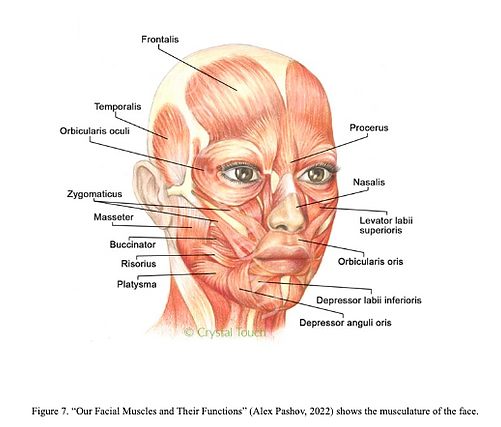
The zygomatic muscles, both major and minor, work to move the corners of the mouth when we smile both outward and upward. These muscles connect to the buccinator, also known as the “trumpeter’s muscle,” which is what engages when one blows out, like playing the trumpet or whistling, or when one is sucking on something, like a sour lemon. The orbicularis oris connects with these other two muscles as well, creating the puckering of the lips, and brings the corners of the mouth to the center. These muscles together help hornists create the “puckered smile” embouchure set up as Farkas and many others recommend.

Figure 8 and Figure 9 both show examples of the “puckered smile.” One can see the firmness in the corners of the mouth, as if one were smiling, but they have a puckered-type center of the lips to create both a stable foundation fo£r mouthpiece to be placed, as well as to create the aperture, or space between the two lips, where the vibration occurs. The more concise the aperture is, the more centered a vibration, which creates a direct sound. If the lips lacked this puckered set up and went for more of a full smile, the aperture would be too wide and the lips would be too relaxed to create a solid foundation and centered sound. While there should be some muscle engagement coming from the lips directly, this is not the main source of where the energy and endurance should come from. The surrounding musculature of the mouth is the primary source of strength for the embouchure, while the lips near the aperture should be tension free, allowing them to vibrate and be flexible.
The chin muscles consist of the depressor anguli oris and the depressor labii inferioris. These two muscles are extremely important in horn playing, but seem to be the most complex in terms of understanding, and learning how to engage them properly. Oftentimes students are told to “engage the chin muscles,” or to have a “flat chin.” This concept, while ideally straightforward, can take years to accomplish physically. The depressor anguli oris’s responsibility is to pull the corners of the mouth downward, as if to create an intense frowny face. There are a handful of horn players who make use of this muscle in the extreme low register very successfully, such as Denise Tryon, who is the former fourth horn of the Philadelphia Orchestra and one of the most exemplary low horn players of today. For others, this method/set up of low horn playing is nearly impossible; one needs to find other ways to navigate the low register. The depressor labii inferioris, however, is a muscle that should always be engaged regardless of the player. This muscle is used to pull down the lower lip when we smile. When the face is completely relaxed, the chin is flexible and free to move. When we smile, the chin becomes engaged using the depressor labii inferioris, which allows for little to no movement in that area. When creating the puckered smile, it is important to take stock of which muscles should be engaged, and which muscles are actually engaged. If the chin is able to wiggle and move around when touched, the chin is not engaged. The player needs to have heightened awareness of this both on and off the horn, as the chin muscles create another layer of foundational stability and allow for proper consistency in playing when engaged correctly. Figure 9 is a great example of proper engagement, as you can visually see the chin muscles engaged in the puckered smile set up.
Dental Structure
The dental structure of a person highly impacts the way one is able to place a mouthpiece on the face. Dental structures are typically separated into three classes of malocclusions, or improper position of the upper and lower dental arches. Class I is representative of those with slightly overlapping teeth, also known as an slight overbite, crowding of the teeth, gaps in the teeth, or an open bite, which creates open space on the edges of the upper and lower teeth when biting down. Class II is a large overbite that is caused by an overgrowth of the upper jaw, or an undergrowth of the lower jaw resulting in this very common dental issue. Class III is consistent with an underbite, or where the lower teeth are set in front of the upper teeth. This can also be caused by a jaw size imbalance.
While many people will proceed with orthodontic work to fix these issues, not all of them have a permanent solution, or an affordable solution. The embouchure essentially needs to work around the different alignments of the teeth, causing a trend away from the standard set up. Many students with dental alignment issues have to work to balance the jaw with an embouchure setting that is comfortable for them. When working with an overbite, three fifths of musicians, both brass players and wind players, have had a hard time adjusting to a proper embouchure. This requires a student to actively push their jaw forward to create a semi-aligned dental structure that is compatible with the placement of the mouthpiece on the lips. The same is true for those with an underbite but requires the opposite movement. The lower jaw needs to either move back into alignment with the upper teeth, or the upper jaw must move forward, which is all dependent on one's anatomy and ability to shift either jaw position. Open bites tend to have less of an effect on the embouchure set up and mouthpiece placement, as long as they are not too serious.
Dental structures that are much more difficult to find an adaptation for are crossbites, maxillary or bimaxillary protrusions, crowding, and spaces. These structures require a more finessed approach to horn playing, and a lot of trial and error. This mainly has to do with comfortability and ability. With maxillary and bimaxillary protrusion, the angulation of the teeth makes it hard to find a setup that has the ability to be supported and increases the amount of jaw movement a player makes. This will require one to make changes as necessary. Crowding, or overlapping teeth can cause an issue with extra lip protrusion, and the fact that sometimes the teeth may cut into the lip if the mouthpiece is improperly placed. This might require one to offset the mouthpiece to either side of the face so there can be a sense of comfortability and support of the embouchure when playing. Minor spacing in the teeth causes little to no issues, while extreme spaces can affect the way the air moves past the teeth and through the mouthpiece and the amount of support the embouchure needs from the teeth. None of these dental factors makes it impossible to play the horn but will require extra attention and patience to create the correct and effective embouchure for each student.